
 Get Premium
This is a historic turning point for Korean esports. T1
- Business
- T1
T1 reports over $60 million in revenue and turns profitable for the first time
This is a historic turning point for Korean esports. T1
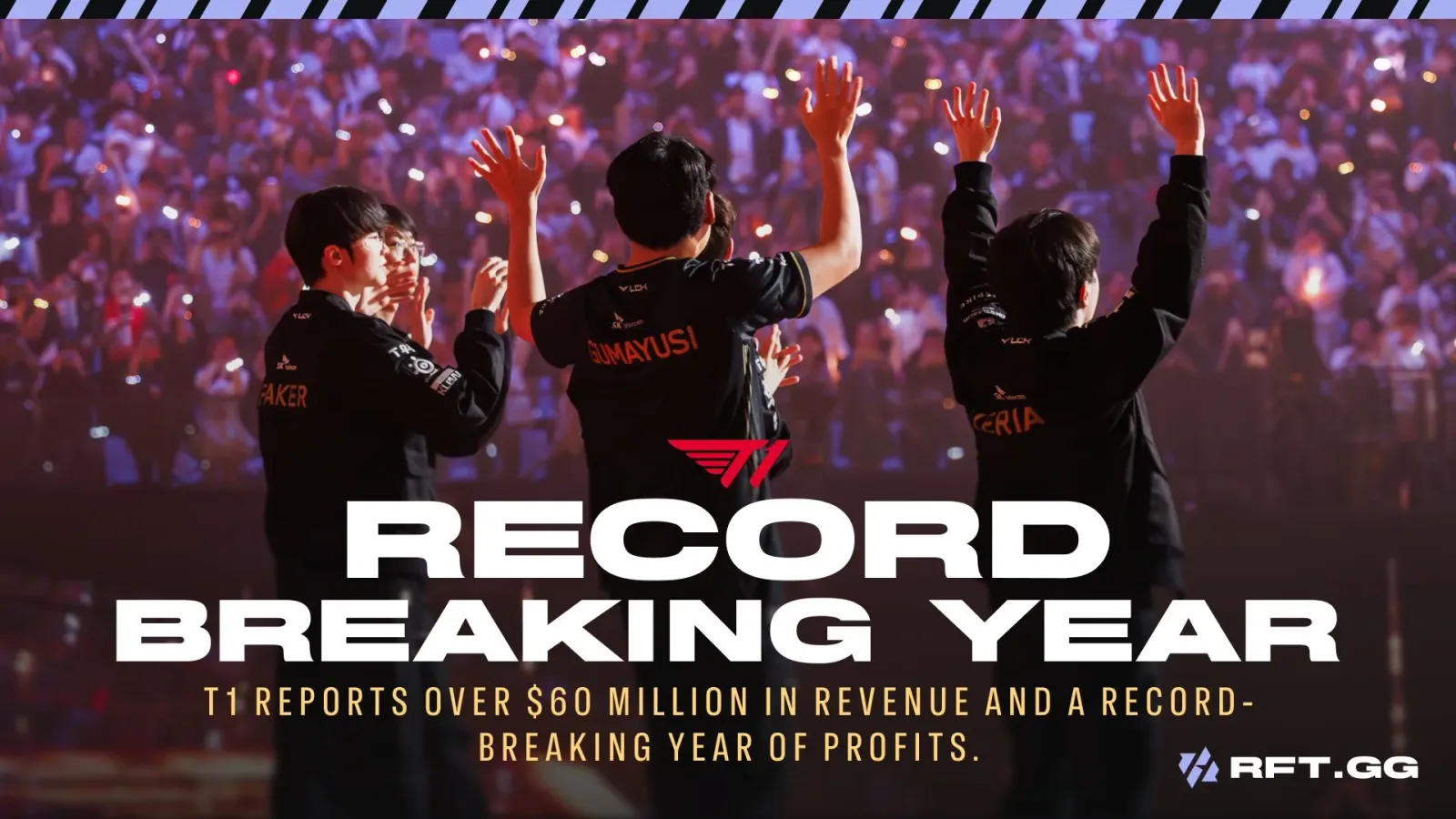
The consolidated accounts for fiscal year 2025, signed by CEO Joseph Marsh, reveal revenue of over $60 million, up from $33.7 million a year earlier, an exceptional 78% increase.
But it is the bottom line that truly stands out: after accumulating nearly $50 million in cumulative losses over six years, T1 delivered an operating profit of $1.4 million and a net income of $555,000. The turnaround is all the more striking when set against the previous fiscal year, which ended with a $4.2 million loss.
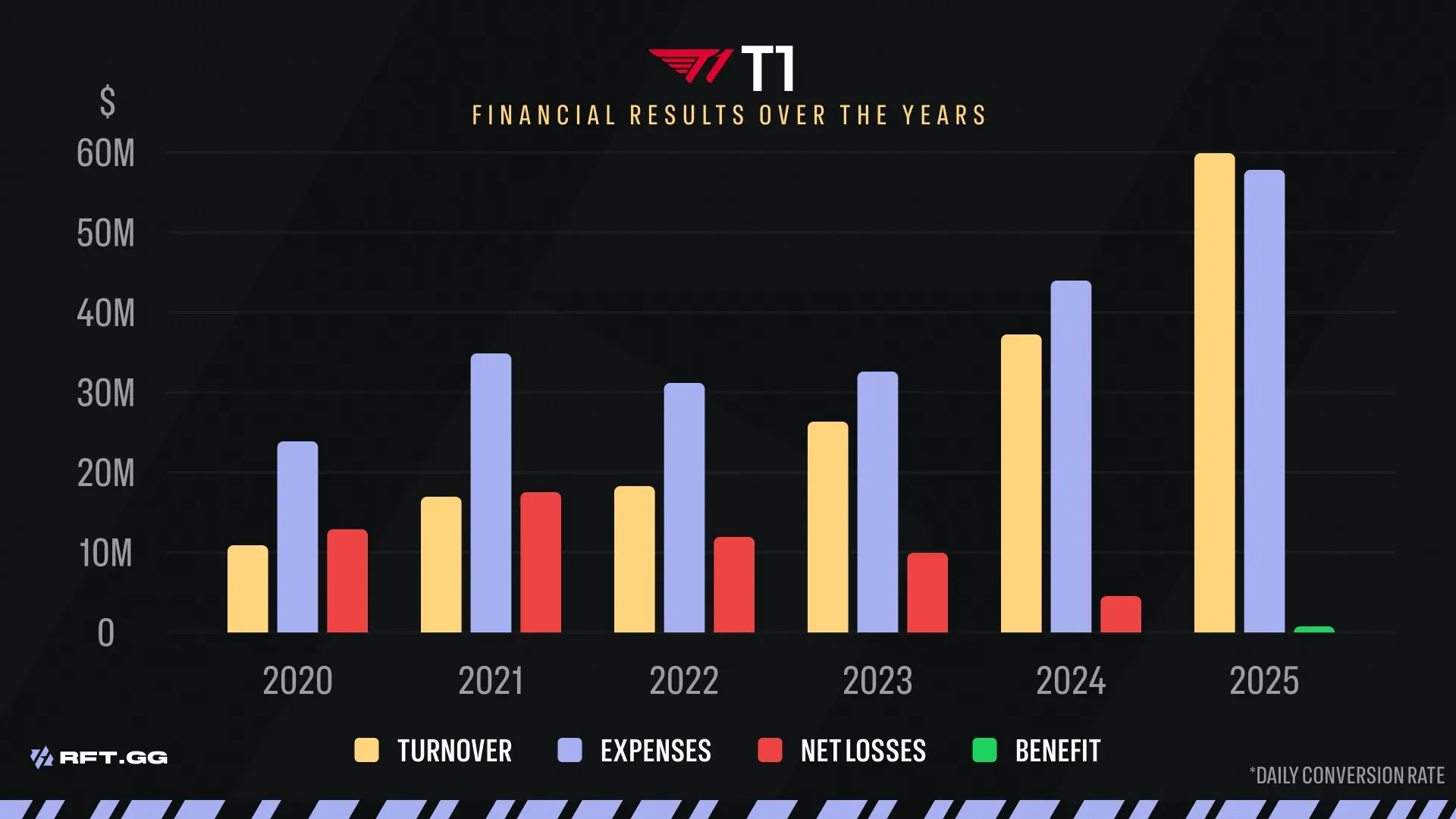
Where does this growth come from? A look at the cost structure provides a major clue: the cost of goods sold surged from $6.3 million to $13.8 million, driving up logistics costs in the process. In short, T1 has become a merchandising powerhouse — jerseys, capsule collections, branded products — the organization has turned its fans' passion into massive revenue, capitalizing on its extraordinary competitive achievements.
The doubling of product inventory amount points to a genuine explosion in sales volume, not just a price increase.
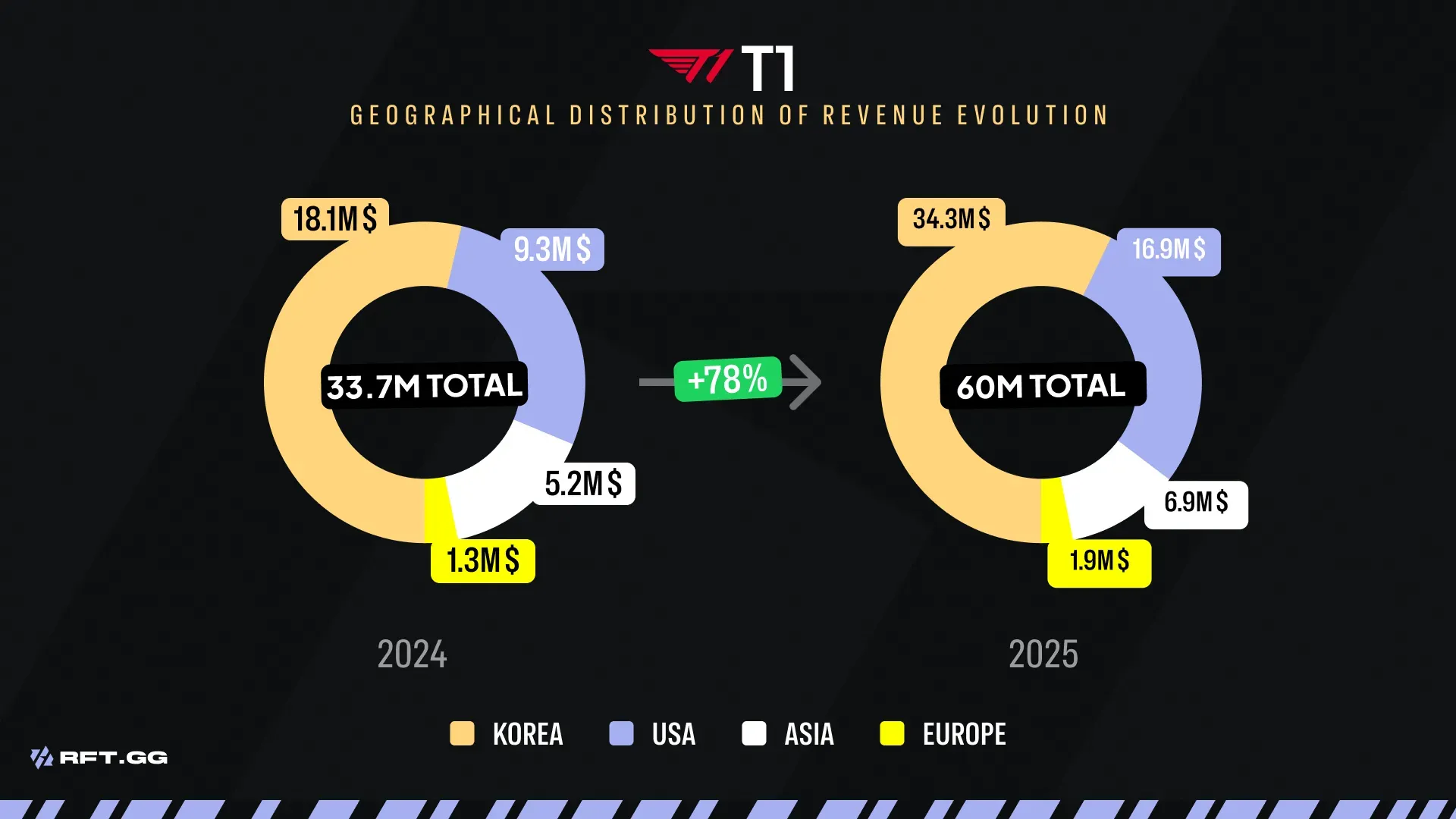
Sponsorship accounts for over $10.5 million, up 51% YtoY. But product sales, esport money and merchandising clearly dominate: $49.5 million, or 82% of total revenue. The doubling of product inventory amount points to a genuine explosion in sales volume, not just a price increase.
Growth is consistent across all regions, with Korea leading the way (+90% YtoY).
The financial statements reveal a significant post-closing event: on March 5, 2026, the board of directors approved a capital increase of 4,330 shares at $1,741 per share, amounting to an injection of approximately $7.5 million — enough to more than triple the company's equity and strengthen the club's financial position.
This amount goes well beyond what would be needed for survival — it is a renewed bet on growth. It reflects the conviction of shareholders SK Square and Comcast Spectacor that T1's model has reached an economic tipping point that must be sustained to endure.
T1 offers the beginning of an answer but one that is uniquely its own. The organization has built its profitability on a combination of factors that are extremely difficult to replicate: an unmatched competitive dominance (six World Championship titles), the cultural capital of a player who has become a global icon in Faker, and a fanbase whose devotion borders on the religious. It is this alchemy that has allowed T1 to turn jerseys into millions and sponsorships into a cash machine. Very few esports organizations have access to such leverage.
A single profitable year does not make a sustainable model, especially when operating cash flow is tightening and debt remains high. And it would be dangerous to generalize: what works for the most titled organization in League of Legends history, backed by SK and Comcast, does not constitute a blueprint for the rest of the industry. But for the first time in its existence, the numbers are telling a new story: T1 is making money. In a sector where almost no one manages to do so, that alone is a victory, even if it remains, for now, the exception rather than the rule.
 K/DA release FIRESTARTER EP, set to perform at Worlds 2026 Opening Ceremony
 Tian on 369’s return for Worlds: “You can feel he still has a lot of passion for the game”
 T1 Oner : "As Long as You Win in the End, Everything Just Disappears"
 Evil Geniuses to shut down all operations on November 2
 GIANTX names iTero founder Jack Joseph Williams CTO as its consumer bet pays off
 Worlds 2026: inside the LCK’s bootcamp solo queue
 Sofm after play-ins exit: “We had absolutely no laning advantage against KC”Worlds 2026 Play-Ins: Our Team of the Stage