
 Get Premium
Riot Games' Player Loan Policy, published as Appendix E of the LoL Esports Global Policies, was last updated on December 10, 2025. The rules themselves are not new.
Loans have been allowed in LoL esports for a number of years. December's changelog simply records the policy's most recent revision, not its creation. EMEA, for context, has operated under loan rules since December 2023. The current version of the document gives the ecosystem a single, consolidated reference point for how loans are governed across regions.
The tier system: where loans can and cannot happen
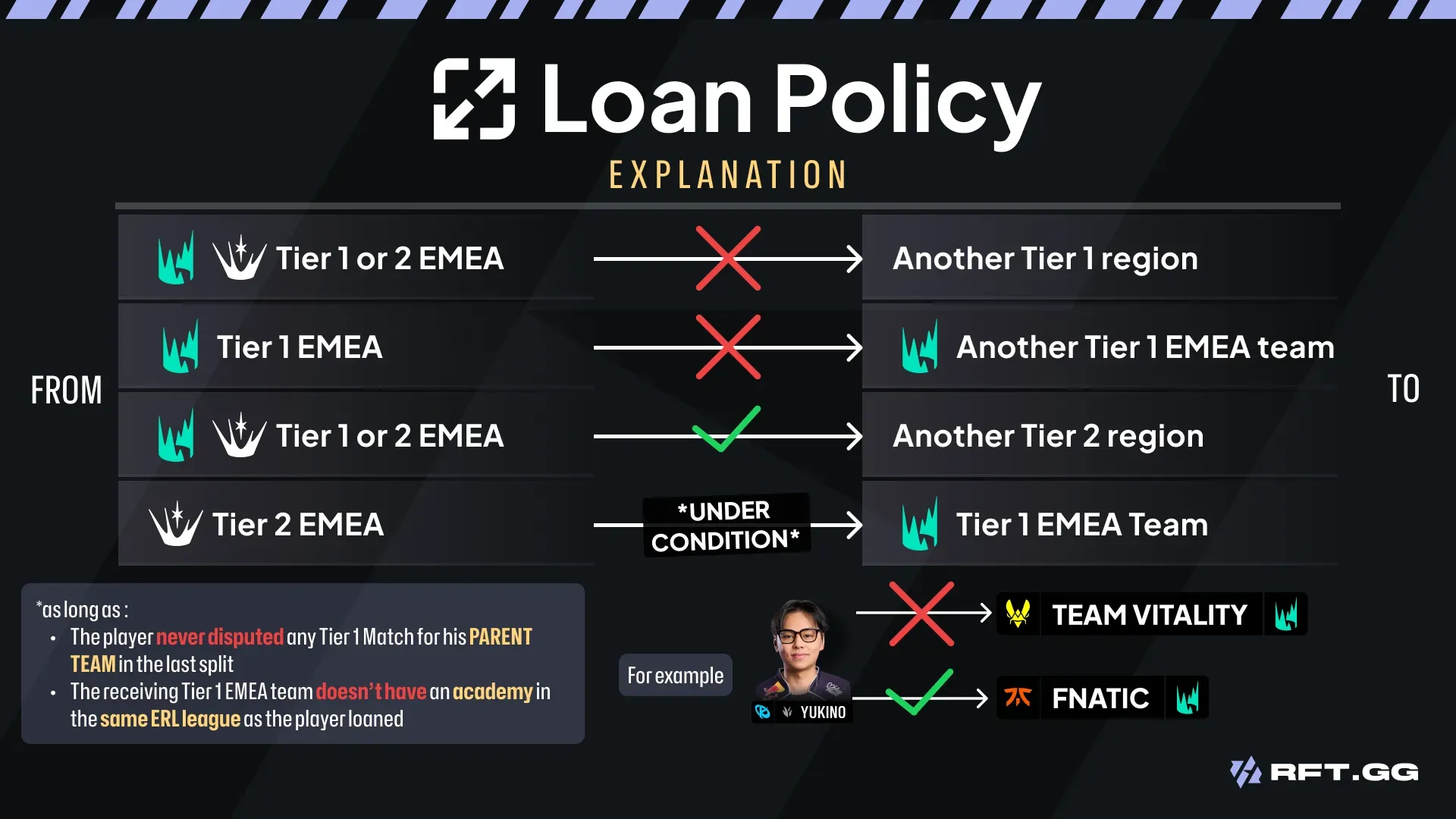
The most consequential rule in the policy is also the most restrictive. Loans between Tier 1 teams are strictly prohibited. Any player who has competed in one or more official Tier 1 match for their parent team during the most recent split cannot be loaned to another Tier 1 team during the current transfer window.
RFT.GG asked Riot why this is the case, given that loans between top-flight clubs are routine in traditional sports.
"Restricting Tier 1-to-Tier 1 loans is part of the global loan policy and is not specific to the EMEA region," Riot EMEA explained. "As it's still a relatively new policy, this approach helps us limit certain types of loans while we assess the policy's overall impact."
The restriction may evolve.
The academy nuance
One important exception is worth understanding. The Tier 1-to-Tier 1 ban applies only to players who have actually competed in Tier 1 matches. A Tier 1 organization with an academy roster in a Tier 2 league — such as the LFL, LES, Prime League, LCK CL or LDL — can loan one of its academy players to another Tier 1 team. At the global level, the only requirement is that the player must not have played any official Tier 1 match for their parent team during the most recent split. Regional rulebooks can add further restrictions on top, as detailed below.
Riot EMEA confirmed this interpretation directly. "A loan of that nature could occur, provided it complies with the rest of the loan policy as well as the relevant clauses in the LEC and ERL rulebooks," it said.
This makes academy programs a strategic asset in their own right, not just a development pipeline.
Other geographic limits
Within the same region, loans are permitted only across tiers. Loans between two Tier 2 teams in the same region are prohibited. Cross-regional loans are allowed only if the receiving team plays in a Tier 2 league. Three-way or multi-party loan agreements are also strictly prohibited.
LEC-specific layers
Article 3.1.13 of the LEC rulebook adds region-specific rules on top of the global policy. An LEC team that operates an ERL academy roster — for instance, a club fielding a team in the LFL — cannot loan players to or from any other team within that same ERL league. The LEC and ERL rosters also count as a single team for slot purposes, capped at four loans combined rather than four per roster.
The same clause confirms that LEC teams remain free to loan a player to Tier 2 teams in other regions, consistent with the global cross-regional rule.
Slots, windows and duration
Each team is capped at two players loaned in and two loaned out at any given time. Teams cannot loan two players to — or receive two from — the same partner club. A loaned player occupies a roster slot in both organizations: inactive at the loaning team, active at the receiving one. They must also be flagged in the Global Contract Database.
Loans can only be opened during off-seasons, never during the Global Lock Period. The minimum duration is one split. The maximum is one full season. Mid-split callbacks are reserved for extreme circumstances and require the consent of all parties, including the league entity.
After two consecutive seasons — six splits — on loan, a player enters a mandatory one-split cooldown.
What must be in the agreement
Every loan must be documented in a written agreement, then reviewed and approved by Riot. The agreement must specify the loan duration, with explicit start and end dates that cannot exceed the player's contract length with the loaning team. It must also detail the financial arrangements, including who pays the salary and how prize money and revenue share are allocated. Side letters are not permitted.
Player consent is the loaning team's responsibility. Players are also free to negotiate "no loan" provisions in their original Player Services Agreement. Buyout conditions, if any, must be written into the loan agreement itself.
The loaned player's original contract is suspended — not terminated — during the loan, and resumes when the player returns. Personal sponsorships and streaming arrangements must either be suspended or temporarily transferred to the receiving team.
Moving forward
Two things are worth watching. First, the Tier 1-to-Tier 1 ban could be revisited as Riot evaluates the policy's impact. Second, academy programs are strategically valuable, since their players are the only Tier 1-eligible loan asset available to top-flight clubs.
The full policy is available in the LoL Esports Global Policies document.
Comments (0)