
 Get Premium
Discord as the Starting Point
We follow a content creator focused on League of Legends, with around 2,000 followers, who receives a private message on Discord. The sender offers him payment — in the region of €500 per one-month wave — in exchange for a few retweets each week. The instruction is explicit: "the arrangement must look spontaneous."
The posts to be shared concern the "probabilities" displayed by a prediction-market platform for League of Legends matches. The creator says he then reread his timeline with different eyes: messages published over the previous several weeks by professional players and coaches, influencers and journalists appear to stem from the same arrangement.
What a Prediction Market Is
Users buy and sell "shares" indexed to the outcome of an event. If the event occurs, the share is worth one dollar; if not, zero.
The vocabulary used by the platforms is borrowed from finance: users are "traders," odds are "prediction trends." The operation nonetheless consists of putting real money on the result of a match — what everyday language, and certain authorities, call a bet.
One example reveals the scale of the sums involved. In June 2026, during an LEC match, a single user lost roughly €238,000 on a single position: he had taken positions on every possible outcome of the match except the exact score that ultimately materialized — a far cry from the savvy "trader."
GRID Esports, Owner of the Official Data
Founded by the creator of sports-odds provider Don Best Sports, GRID captures in real time, directly from game servers, every event in a match: player statistics, game states, detailed actions. These feeds are resold to betting operators, media outlets and professional teams.
In late November 2023, Riot Games, publisher of League of Legends, made GRID its exclusive data provider for three years. Riot also took a stake in GRID, through a non-voting participation — meaning no influence over the company's decisions.
In September 2025, GRID acquired its competitor Bayes Esports, then in liquidation. Since then, the company has held the majority of the rights to official data in global esports.
Riot Games: The Opening
On June 26, 2025, John Needham lifted this ban for tier-1 competition: the top League of Legends and Valorant teams in the Americas and Europe may sign with regulated betting operators. The argument put forward is one of control: betting activity already exists around these competitions and will continue regardless of the publisher's position. Riot cites a Sportradar estimate putting the sums wagered on these two games at $10.7 billion for 2024 alone, of which roughly 70% on unregulated markets.
Any operator wishing to offer official bets on these games must purchase its data from GRID, which became the official esports data partner of Polymarket, then of Forkast.
Markets on the Publisher's Decisions
In August 2026, Polymarket announced a new category of markets. These no longer concern matches, but Riot Games' decisions: "which organizations will the publisher select as top-tier partners for its Valorant circuit?"
The nature of the "trade" changes completely. A match takes place under refereeing and its result is established by official data. A partner selection is an administrative decision, made behind closed doors by a small number of people, according to non-public criteria — nothing more than an internal deliberation. The circle of people informed before the public is, by default, limited and identifiable: candidate teams and their executives, advisers, service providers of every kind.
Asked about the markets themselves, Riot Games' communications team responded:
The markets offered on Polymarket are created independently. Riot's primary focus remains upholding the competitive integrity of our esports by enforcing the established rules and policies governing the conduct of teams, players, and other participants in our ecosystem, regardless of activity on external platforms.
As of this date, the market no longer appears among the platform's active markets; a market can be withdrawn for many reasons: insufficient liquidity, internal review, a third party's request.
Markets on Player Transfers
The logic behind these markets persists. The platform hosts, for example, a market titled "Will T1 make a roster change before July?", which settles on any signing, transfer, benching or departure of a player from the team in question. An entire category, "Player Transfers," groups together some twenty markets of the same kind.
The transfer window thus becomes an asset on which to take a position. Yet this is the area where information circulates earliest, and within the widest and most informal circle: players, staff, agents, but also relatives, translators and scene insiders.
GRID's data, reliable for establishing a match result, is of no use on this field: the information originates outside the servers. The risk is structural, and it sits exactly where regulation is weakest.
The Amplification Scheme on X
According to testimony gathered, written exchanges and recordings we were able to review, the amplification scheme is unique within the ecosystem and organized on an industrial scale.
The network is described in writing as comprising "80+ creators/pages." The creator we interviewed reports being told verbally of more than 200 accounts. Coordination is said to run through a Discord server:
- With every post from the PolymarketLoL account or from a partner promoting prediction trends, members are pinged and can share or pass.
- Never two posts on the same day.
- The rate is fixed and negotiated account by account, based on impressions, reach and the deliverables requested.
In the documented cases, the intermediary offers our 2,000-follower creator $20 to $25 per quote post, then confirms $40; the creator asked for $60, and negotiations remain open. At three posts per week, the pay would come to between $400 and $700 per month. For larger creators, the sums can reach four figures per month.
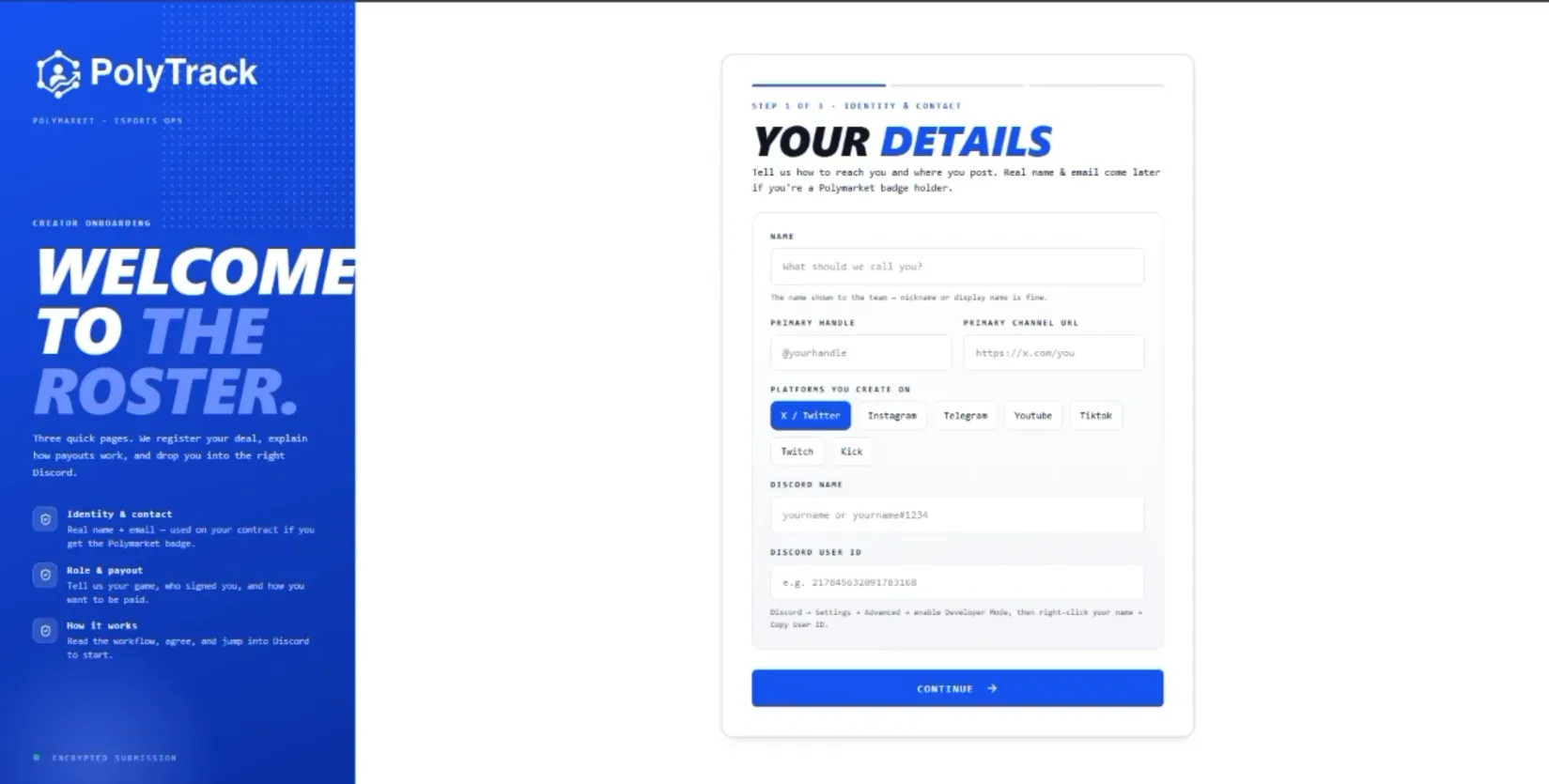
A dedicated tool, named PolyTrack and subtitled "Polymarket · Esports Ops," is said to record the agreement, tally the posts and propose settlement at the start of each month, by PayPal transfer or in cryptocurrency.
No figure from the scene is named here, but the Discord server includes journalists, active professional players, coaches and streamers.
When dozens of accounts quote the same message on the same day, an outside observer can no longer distinguish sincere endorsement from paid service. The impression forms that the entire community has already converted to these markets. This artificial manufacturing of consensus has a name: astroturfing.
Faced with this scheme, the esports ecosystem — still young and financially fragile — has few counterweights. Two actors could provide one: the regulator, on the legal classification of the activity and on advertising transparency, and Riot Games, as administrator of the intellectual property.
Transparency note. This investigation covers the period from June to August 2026. The testimony concerning the influence scheme comes from several content creators, as well as from written exchanges and recordings we were able to review. The loss of approximately $238,000 is based on a review of purchase histories on Polymarket. Riot Games responded on prediction markets, then declined to comment further. GRID had not responded at the time of publication.
In addition, according to Bloomberg, Riot has reportedly begun discussions with Polymarket and Kalshi to expand existing partnerships to include sponsorship deals
Comments (0)