
 Get Premium
 LCK

Faced with an illegal market estimated at €14 billion, Seoul is launching the biggest overhaul of Sports Toto in twenty years. Esports is among the candidate disciplines, and the Korean community is already debating the consequences.
On September 4, the Korean Ministry of Culture, Sports and Tourism (MCST) unveiled its "Sports Policy Vision 2030". Among its thirteen priority projects, one point stands out for the esports scene: the complete overhaul of Sports Toto, the country's legal sports betting system, with the addition of new disciplines including esports.
According to government data, the illegal sports betting market reached 21.7 trillion won in 2025, roughly four times the size of the legal market. Vice Minister Kim Dae-hyun summed it up at the September 2 briefing: Sports Toto is the main source of funding for the national sports promotion fund, yet its operation has barely changed since its creation.
How legal sports betting works in Korea
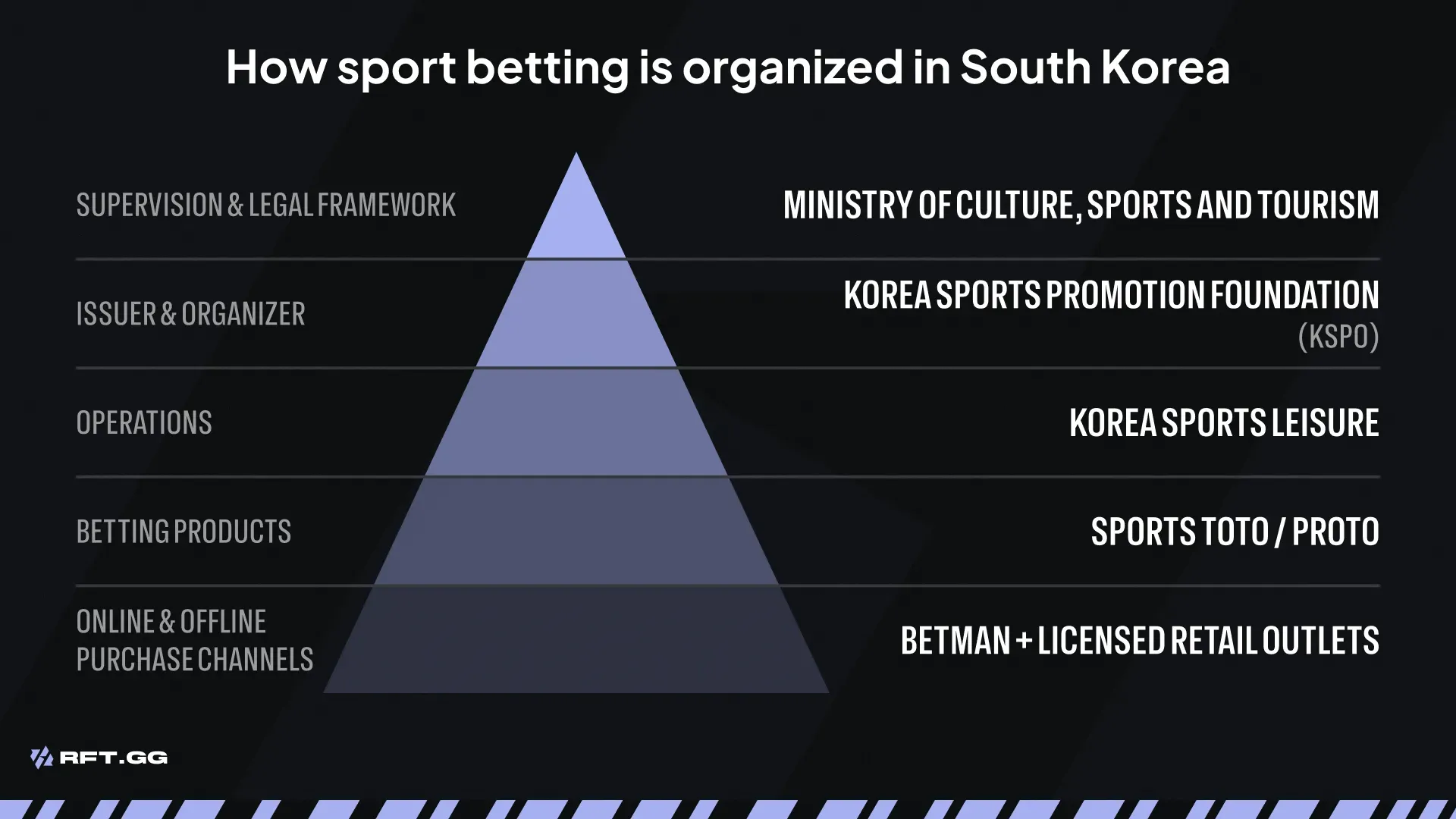
Unlike in Europe, there is only one authorized operator. Today, the framework is as follows:
- Only five disciplines: football and basketball (since 2001), golf and baseball (2004), volleyball (2006).
- Limited sales hours: from 8 a.m. to 11 p.m., which effectively excludes most European matches.
- Online purchases on PC only, via Betman. No official mobile app.
- Payout rate of around 64%, compared with 72 to 75% for cycling races, motorboat racing, horse racing or casinos, and an estimated close to 90% on illegal sites.
- Betting cap of €65 per round, unchanged since 2001.
What is set to change by 2030
The timeline announced by the ministry is gradual:
- 2027: launch of an official mobile service, phased extension of sales hours to cover late-night matches, gradual increase of the payout rate, and raising the betting cap from €65 to €130 (amendment to the enforcement decree of the National Sports Promotion Act).
- 2028: introduction of live betting during matches or broadcasts, starting with domestic competitions. This is also the deadline set for adding new disciplines: table tennis, handball, billiards, and esports, cited as an official Asian Games discipline.
Asked about the scope, Kim Dae-hyun clarified that the list is not fixed: a selection committee will apply criteria defined by an external study, and any discipline that meets the requirements may be added.
An enforcement component entrusted to AI, with KAIST
The government wants to build, by 2028, a real-time detection system for illegal sites, capable of identifying and documenting them and automatically forwarding cases to investigators and blocking authorities. The project is being carried out with KAIST, the country's most prestigious science and technology research institute, based in Daejeon and often compared to MIT.
The urgency is real: the average time to block an illegal site rose from 68 days in 2022 to around 140 days in 2023 and 2024. Seoul also plans to freeze bank accounts used for illegal betting, is considering administrative fines, and will raise the reporting reward to €320,000.
Korean esports fans agree on the principle
On Korean portals, the most upvoted comments on the news point in the same general direction, but the nuances are there.
The most liked comment sums up the prevailing pragmatism: the illegal market keeps growing and neither regulation nor sanctions can stop it, so why not legalize fully, collect taxes and fund good things with the money. But its author immediately adds two conditions: permanent monitoring against corruption, and heightened vigilance on smaller disciplines, where the risk of manipulation is highest. A remark that directly targets esports, where match-fixing scandals have already left their mark on the Korean scene.
The apparent consensus therefore hides a real debate: legalize to dry up the black market, yes, but at what cost to the integrity of competitions? For a discipline like esports, where rosters are young, salaries vary wildly from game to game and second-tier competitions are numerous, the question of match monitoring will arise before the first odds are even published on Betman.
Answer expected in 2028, when the selection committee delivers its verdict on the disciplines selected.
Comments (0)