
 Get Premium
 LCK
The Korean esport association published a 150-page study on February 20 examining the economic impact of esport in South Korea. Behind the record figures put forward lies an open political case for tax reforms and inclusion in the Sports Toto system.
The Korea e-Sports Association (KeSPA) is the longstanding governing body of South Korean esport. Founded in 2000, it marks its 25th anniversary under unprecedented circumstances. Its audited accounts for fiscal year 2024 show revenue of approximately $4.9 million, down 24% from 2023, and a net loss of $330,000, a 45% deterioration year-on-year.
Government subsidies remain its primary source of income at $1.95 million (39% of revenue), followed by league management fees ($1.65 million, 33%). In other words, KeSPA is a lean, loss-making organization that no longer holds the LCK Corp, which was absorbed by Riot Games Korea on September 30, 2025.
It is against this backdrop that the association unveiled, on February 20, a study titled "Economic Effects of Esport Tournaments and Measures for Expanding Tax Benefits." The 150-page document was produced in collaboration with game publishers, teams and industry stakeholders, with a clear objective: to demonstrate, figures in hand, that Korean esport generates tangible economic value — and that it deserves greater public support.
The headline : $514 million for Worlds 2023
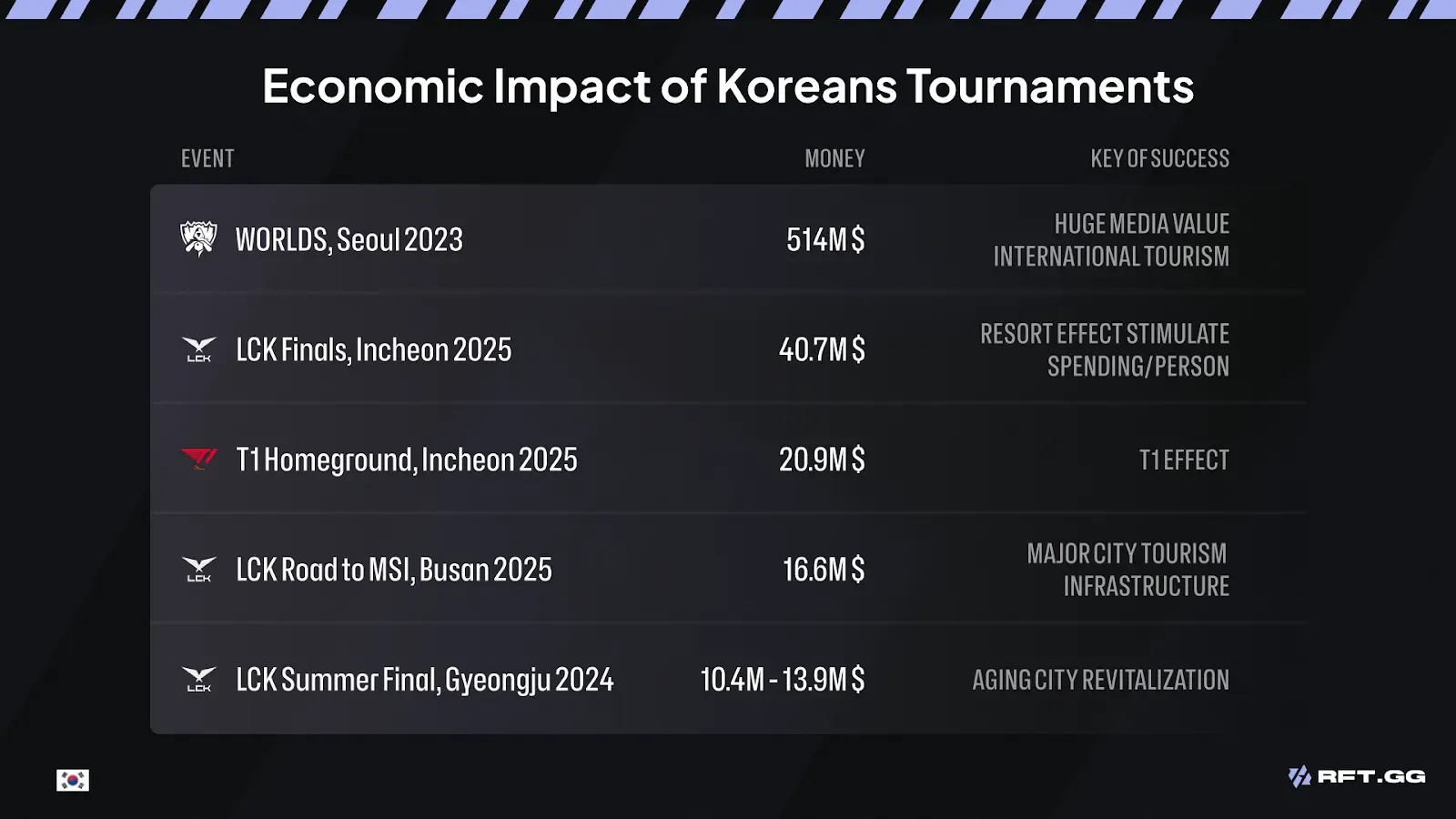
According to KeSPA's estimates, the 2023 League of Legends World Championship held in Seoul generated approximately $514 million. That is 3.7 times higher than previous assessments, which placed the event's economic impact between $153 million and $200 million.
The model incorporates a "quantified sponsorship value" broken into two components. The first is media value: sponsor logo exposure time is converted into an equivalent advertising rate, based on hundreds of millions of viewers.
The second component is more unusual. KeSPA adds a "client expansion value," estimating the future revenue generated by new consumers acquired through the event. The concept is borrowed from corporate marketing and is not typically included in standard economic impact studies.
The economic reach of Korean events
KeSPA presents a table summarizing the estimated economic impact of Korean esport events.
A well-documented structural paradox
Beyond the impact figures, the study lays bare the economic fragility of the sector. In 2021, $58 million was invested in Korean esport, yet only $22.7 million (39%) was converted into revenue. Player salaries account for over 70% of team budgets, and the ten LCK franchises have accumulated more than $69 million in combined losses over three years. Even T1, the league's most iconic franchise, reported revenue of $22.6 million in 2023 against an operating loss of $8.3 million.
KeSPA describes this situation as a "growth paradox": the more teams invest to remain competitive, the higher costs climb, and the deeper deficits run. League-distributed revenue, approximately $572,000 per team in 2022, covers only a small fraction of operating expenses. Dependence on sponsorship remains overwhelming, and that sponsorship is itself volatile. LCK Corp had recorded a cumulative net loss of €26 million between 2022 and 2024, before its reintegration into Riot Games Korea.
A fiscal and financial manifesto
The study carries a clear political agenda. KeSPA is calling for changes to tax credit mechanisms, specifically the expansion of eligible expenses to include marketing, temporary staffing and broadcast production costs. Citing international esport bodies such as France Esports and the Savvy Games Group, KeSPA warns that South Korea's standing as the birthplace of esport is no longer guaranteed.
The central argument: the Korean film and audiovisual industries already benefit from similar mechanisms, and esport, given its forthcoming international exposure — MSI 2026 and Worlds 2027 are both scheduled to be held in South Korea — deserves equivalent treatment. The timing is deliberate. On February 19, one day before the study's release, lawmaker Kim Seung-soo introduced an amendment to the Special Tax Restriction Limitation Act aimed at extending tax benefits for regional competitions.
The report also explores integrating esport into Sports Toto, the South Korean legal sports betting system that funds the promotion of national sports. Esport is currently excluded, and KeSPA is actively lobbying for inclusion, arguing it would help finance lower-tier leagues, regional teams and player career transitions. KeSPA raised the issue again in 2025 with the Democratic Party, without success. To build its case, the association proposes a 1 to 2% levy on wagers redistributed to game publishers, along with the creation of a dedicated integrity body, the "K-ESIC." KeSPA itself acknowledges that significant obstacles remain: legislative changes, public acceptance and publisher cooperation.
Critical reading
The figures are impressive, but it is KeSPA itself that produces them, and the association has every incentive to inflate the value of the sector it represents. Its model relies on coefficients set internally, without external audit, and for Worlds 2023 they are all pushed to their upper limit. The model combines real values (spectator spending) with intangible ones (media exposure, estimated new customers), then applies an economic multiplier to the total — as though all of it represented money actually spent in the local economy. That is where the figure jumps from $200 million to $510 million.
The study nonetheless remains a rare document: hard data, a detailed international comparison and a concrete policy roadmap. Whether or not one accepts the amounts, KeSPA asks the right question: how to turn a sector that generates viewership, tourism and international visibility into a viable ecosystem for those who sustain it.
KeSPA study — "Economic Effects of Esport Tournaments and Measures for Expanding Tax Benefits" (이스포츠 대회의 경제적 효과와 세제 혜택 확대 방안), published February 20, 2026, available on the KeSPA website.
Comments (0)