
 Get Premium
Two weeks after the LCK rewrote its spending rules, it is the LEC's turn. Riot has published version 1.3 of the LEC Sporting Financial Regulations (SFR) rulebook, dated September 24 — and behind the technical updates sits a clear direction: the cap is coming down, hard, just as the offseason approaches.
A quick reminder of how the SFR works
Unlike a hard cap, the SFR taxes overspending on star salaries. Only each team's five highest-paid players count toward the "SFR Spend," measured against a threshold: exceed it, and the team pays a fee. 50% of the excess up to 150% of the threshold, 100% beyond that, with a 5% grace band that turns into a flat fee if abused twice in four seasons. The proceeds are split 50/50: half to compliant teams that also met the spending floor, half to the league — earmarked, notably, for the ERLs and EMEA Masters.
The cut: from €2 million to €1.65 million
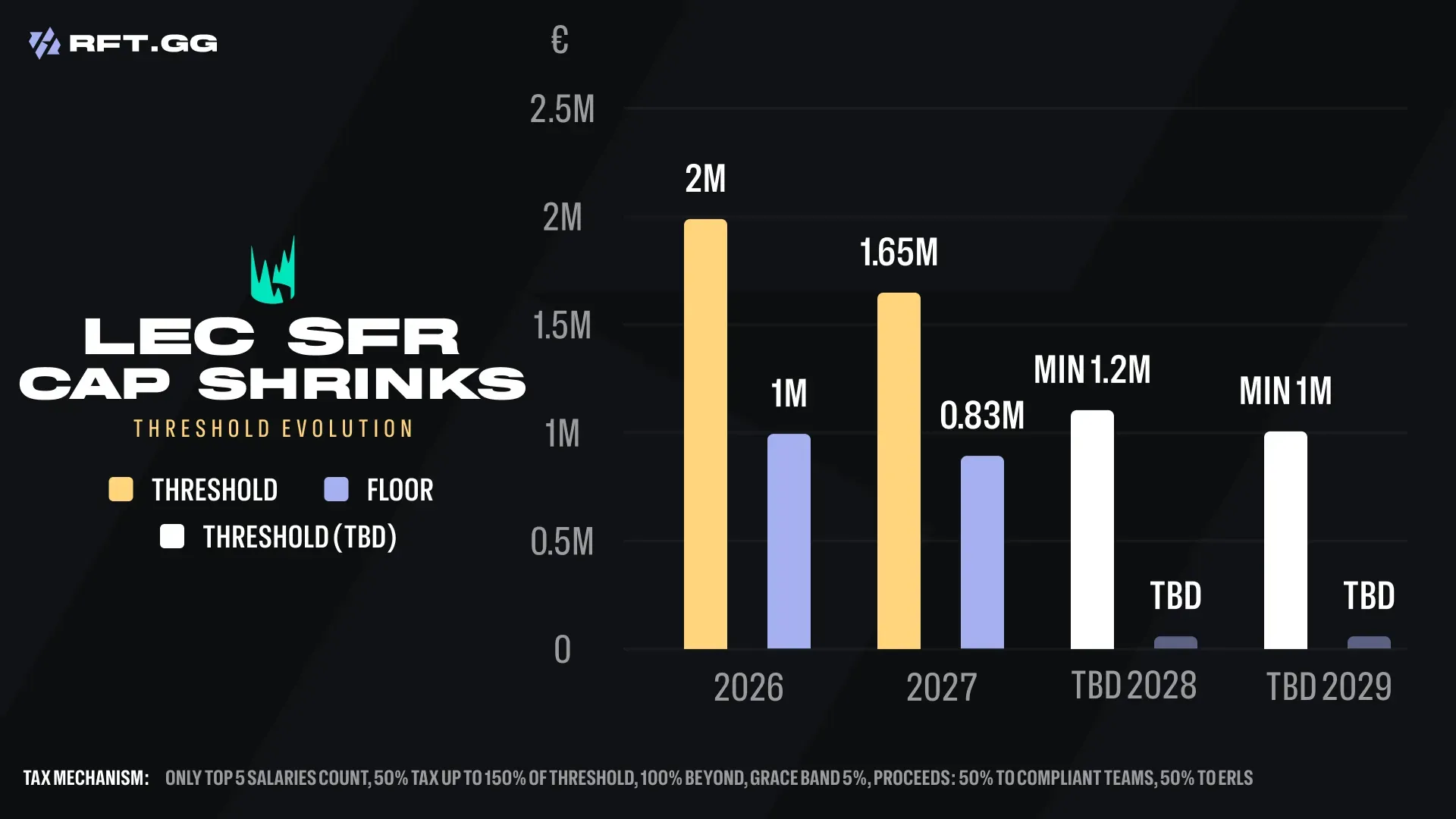
Since the system launched in 2024, the threshold had sat at €2,000,000 with a €1,000,000 floor. Version 1.3 sets the 2027 season at €1,650,000 — a 17.5% cut — with the floor lowered to €825,000. And the squeeze is structural: the baselines already published point to €1,200,000 for 2028 and €1,000,000 for 2029. The message to teams is unambiguous — the era of €2 million star payrolls is being wound down, season by season.
A legacy shield for existing contracts
The blow is softened by a brand-new clause: "Legacy Contract Protection." Any contract signed on or before September 16, 2026 counts toward the SFR Spend at a maximum of one fifth of the threshold (€330,000 for 2027) or its actual value, whichever is lower. Extensions only carry the protection until the original contract's end date, and the reduction does not help a team reach the floor.
It is the second grandfather clause in the system's history, mirroring the "Existing Players" reduction from the 2023 launch — and the same philosophy the LCK just adopted: protect the deals already on the books, and let the new rules bite on everything signed after the cutoff. The practical effect for the offseason is significant. A star re-signed after September 16 counts at full price against a smaller cap; a star locked into a long deal before it costs a fifth. Teams that secured their cores early enter the market with a structural advantage.
Winners who didn't expect it
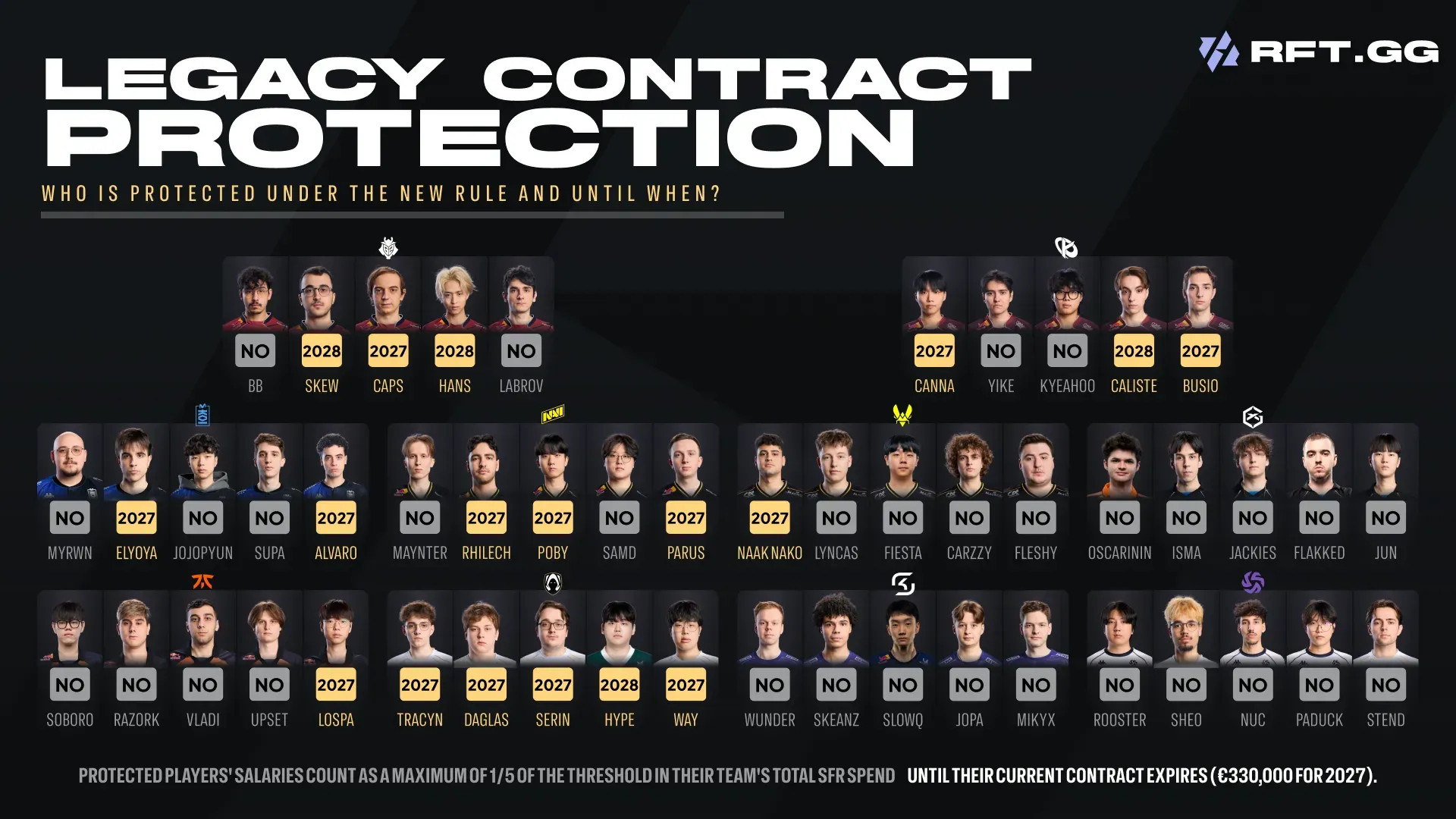
The list of winners is already taking shape. G2 Esports are the biggest one: Rasmus "Caps" Winther — known to carry the largest salary in the league — is under contract through 2027, and the organization extended Hans Sama and SkewMond through 2028 earlier this year. Karmine Corp are not far behind, holding Caliste through 2028 and both Canna and Busio through 2027, and Movistar KOI locked Elyoya and Alvaro through 2027 — all comfortably before the cutoff, all now counting at €330,000 apiece at most on the SFR. The cautionary tale may be Jojopyun: his extension was apparently signed only days ago, which could place it on the wrong side of September 16 — the difference between a fifth of the cap and full price.
The new numbers take effect with the 2027 season, which opens with the Global Contract Window on November 17 — meaning every negotiation of the coming offseason happens under the new math.